
Monday, 24 August 2015

Sunday, 26 July 2015
My 10 favourite SF novels
 |
| 'Oryx & Crake' and 'The Drought' missing in action... |
When compiling this list I thought about the books which have left enduring impressions on me, whether these be images, atmospheres, ideas or characters. My imagination tends to be cinematic – as I read the images roll over the screen of my mind, and the more striking the better. In my novel ‘The Scion’, I tried my best to write what I was seeing, which gave the book a visual feel. My hope was that some of the images I’ve created would have the same kind of long-lasting effect as the books I most admire.
This is a book I return to again and again. It was the first McAuley I read and one
of the books that kickstarted my interest in SF. The descriptions of a terraformed Mars jolted my imagination
awake, the settings lingering in my mind.
I had the pleasure of meeting the author at Worldcon last year, when he
told me (as he signed my first edition hardback) this was one of his
favourites. I just smiled, being a
bit starstruck.
Where would we be without the late, great Iain M? This book has it all – some wonderful
set pieces, epic landscapes and a seriously cool female lead to boot. An antiquity hunter, Sharrow is a
strong and believable character.
The Lazy Guns are without comparison and possibly one of the coolest
inventions in SF. Added to which
there are monowheels (a kind of supercharged motorbike), cable cars,
glass-bottomed swimming pools, hovercraft… Dark, as the title suggests, humorous and a book which grows
on second, third and fourth reads.
The author of this novel may not consider this to be SF, but
I do. Science has effectively
destroyed Earth, after the release of Crake’s monster virus (SF, right?). The grim post-apocalyptic tone of this
book takes hold from the outset and doesn’t let go. But there is a lesson here for humanity – about what could
happen if science’s advances are allowed to progress unchecked. This is Frankenstein for our
times. It could really happen one
day.
A brilliant Banksian rollercoaster ride on the ridiculously
named planet of Spatterjay, where a plethora of bizarre creatures grow with
abandon. The drones in this are
seriously sophisticated, kick-ass machines. And the transformed Hoopers, infected by the Spatterjay
virus, are a nice touch. Asher’s
finest moment.
5. The Dramaturges of Yan – John Brunner
5. The Dramaturges of Yan – John Brunner
An alien world filled with ancient artefacts, a galaxy known
artist who creates on a celestial scale, the strange effects of the Shrimashey
drug: Brunner manages to summon a world which is fascinating and truly
strange. There is even a kind of
internet (written before this existed).
At the same time, there is something very Seventies about this book,
which doesn’t seem to date it, but instead gives it a retro feel.
More artefacts, this time a mysterious eponymous space hub
created by a vanished race called the Heechee. Travelling on the alien craft located in the hub to
different worlds is a kind of Russian roulette, with the accompanying financial
rewards making this a space race on a different scale. The analysis sessions through which the
protagonist reveals the secrets of Gateway lend a humanising context. I read this for the first time in one
sitting, spellbound, each new world visited as thrilling as the last.
No best SF list would be complete without some Ballard. This was one of a series of apocalyptic
novels, although they are otherwise unrelated. His writing is clinical, detached and paradoxically
completely submerges the reader in a world without water. Reading this is like being transported
into a surrealist landscape, where nothing quite makes sense. There is a mirage-like touch to the
prose that sticks, like your tongue to the back of your dry mouth.
This book opened my mind to the unbelievable depth of
space. That hundreds of civilisations
could have lived and died before humans even emerged from the cat’s cradle of
evolution on Earth. Of course, in
Rama itself, there is an alien artefact which requires exploration (you
detecting a theme here?). And,
yes, space really is that big.
9. The Day of the Triffids – John Wyndham
9. The Day of the Triffids – John Wyndham
I was brought up with the Triffids. They were there on the television
creaking around through 80s TV sets and devouring people. For a while I thought they were real. Later I consumed the book like the voracious
Triffid reader I am. The idea of
the meteor show blinding Earth’s inhabitants, rendering them powerless to the
Triffids’ advances is haunting and I still have a mild panic attack any time I
hear of (or even witness) a meteor shower.
10. Stone – Adam Roberts
10. Stone – Adam Roberts
Roberts turns his hand to many different tropes in SF, his
books diverse and fascinating.
Here he does space opera on a grand scale, whizzing through many
different exotic planets with an assured prose. And for his third outing, this feels like a book from a much
more experienced writer. High
concepts abound: faster than light travel, quantum physics and intelligent
nanotechnology (dotTech) which has created a kind of human utopia (or has it?). On reading this, I almost shouted with
joy, revelling in the fact that modern SF has so much to offer. Simply breathtaking.
This blog post originally appeared on Margo Bond Collins' blog on the 7th July 2015, as part of the blog tour for my novel 'The Scion'.

Wednesday, 15 July 2015
Some stuff about aliens
I’ve met many aliens during my brief time on Earth. None to my knowledge in reality, but
many through millions of words and fictional worlds I’ve avidly consumed over
the years. These have no doubt
informed the way I’ve created aliens over the years.
It is hard to avoid cliché when creating an alien. In a
gravity different to Earth, they could be taller or shorter; their atmosphere may
be completely different; they may have completely different food sources and
will no doubt support different microbiomes which may have in turn channelled
their features. Carbon-based
lifeforms are mostly likely according to the higher echelons of SETI, but that
doesn’t mean to say other forms are unlikely. Many authors use silicon as the predominant building block,
although Silicon-based compounds are inherently more unstable, and other
elements even more so. In any case,
it seems that when considering this that they will be like us in any shape or
form. But is this strictly true?
We have seen so called biological or physical attractors in
evolution on our planet – look at how the octopus eye and human eye, have
developed independently along completely different evolutionary pathways – so-called
convergent evolution. Are
humanoids clichés or an inevitability?
I tend to think the latter.
Although this isn’t to say there won’t be other differences. Although, this is probably a
presumption based on a carbon-based lifeform, which has evolved in a similar
‘Goldilocks’ zone to Earth. This
could explain why we see so many humanoids in SF, for example in series like
Banks’ Culture.
So should aliens be feared or should we be grateful for
their presence? If aliens do ever
make contact, then they would surely be of at least a technological parallel to
ours, if not more advanced. There
is a good chance they may be able to help us out, let us piggy back off some of
their technologies, such as the McAuley’s Jackaroo. This doesn’t mean to say they won’t want something from us,
whether it be elements of our culture, or at least, a calm, focused approach to
their presence. Humanity doesn’t
have a great record when it comes to dealing with members of our own species,
let alone others. Could this be
one of the reasons why they haven’t yet contacted us?
This brings me to Fermi’s paradox, the contradiction between
the thought that given the four hundred billion stars out there in our galaxy,
there is a high probability some must harbour civilisation, so why don’t we
know about them? Is there an alien
race out there, truly to be feared, like Reynolds’ Inhibitors, which extinguish
everything as soon as it starts propagating beyond certain pre-defined limits? Have their civilisations blossomed and
died already on the vast canvas that is space and time, such as those which
created the cylinder of Rama? Is
it because we inhabit a part of the Milky Way lacking enough dark matter for
subspace transport? Or are we simply
too immature as a species, too intolerant and irrational to intelligently deal
with them?
Is it highly likely that aliens are out there, somewhere, or
maybe even moving amongst us.
Whether they will be able to help us or thwart us as a species is likely
to depend on how we react to their presence. But until they make themselves known to us, we have to rely
on conjecture, and sometimes fantasy.
In the meantime, they can make good stories and help explain elements of
ourselves, preparing us for that moment which will shake us a species, but
perhaps bring out the best in us.
References:
Banks, I. M. Consider Phlebas. Macmillan. 1987
Clarke, A. C. Rendezvous with Rama. Gollanz. 1973
McAuley, P. Something Coming Through. Gollancz. 2015
McGhee, G R. Convergent evolution: Limited Forms Most
Beautiful. Vienna Series in Theoretical Biology: Massachusetts Institute of
Technology Press, Cambridge (MA). 2001
Reynolds, A. Revelation Space. Gollancz. 2000
Shostak, S. The bricks of life: exploring the idea of alien
chemistry @ teamSETI.org. 2004
This blog post was originally written for 'Beauty In Ruins' and was posted on the 6th of July, 2015 as part of the Blog Tour for 'The Scion'.
Wednesday, 1 July 2015
Music for The Scion
I find it hard to write without music. I need it to transport me to that other place where writing comes naturally. Think of it as jump starting my imagination, the battery of which has become flat due to the excesses of work in a busy hospital. So it goes without question that I listened to many different notes whilst writing 'The Scion'.
It doesn't come as much surprise that many writers have music on in the background during the creative process. SF writer Al Reynolds reportedly played lots of Interpol loudly while writing 'Revelation Space'. And another Al (Robertson) writes beautifully how music was important to him when writing his recently published SF novel 'Crashing Heaven'.
Much of the music which vibrated my tympanic membrane during the 112,000 or so words and various edits of 'The Scion' comprised instrumental pieces - these seemed better suited to the atmosphere I was trying to create (and possibly prevented copyright issues with lyric creep). Some of these artists I like to think of as purveyors of SF music, or at least music which goes some way to explain the unfathomable depths of space and the alien worlds surely out there. Music, in its inexplicable way, explains the unexplained. Tangle your headphone wires around that one.
This was a playlist I made for my friend Dr Rich Grenyer back in 2012 or so as 'accompanying listening' to 'The Scion'. Think of it as the novel's soundtrack if you like. Not all tracks are available, including one I wrote (with a different friend) which may never see the light of day. But you get the gist.
1. Glink - Bola
2. Witches Ov - The Black Dog
3. Imp - Yimino
4. Monkey Back In - Mrs Jynx
5. Phontron (030303 mix) - EOD
6. The Great God Pan Is Dead - Johann Johannsson
7. Sphere Of No-Form - Biosphere
8. Goodbye - Ulrich Schnauss
9. Sticklebrick Symphony - Ochre
10. Cold Out There - Jon Hopkins
11. Hoy Yoi - Yimino
12. Love Movement (Ulrich Schnauss Remix) - Justin Robertson
13. How I Missed You - Clatterbox
14. Demo 4.1 (Unfinished End Titles) - Element 33
(not available)
Wednesday, 24 June 2015
The Scion now on Amazon (pre-order), Blog Tour and Other Stuff

Amazon:
My novel The Scion is now available to pre-order from Amazon! It is coming out as an eBook only. Although, you never know, they might kill some trees and spill some ink later on...
Europe Links:
UK, France, Germany, Italy, The Netherlands, Spain.
Non-Europe Links:
US, Canada, Australia, Japan.
The Scion Blog Tour:
Some lovely people have said they will entertain some of my words on their sites. Fist up, I've got a piece about aliens coming to Beauty In Ruins on 6th of July. Then a top 10 of my favourite SF novels to Words, Words, Words on the 7th July. More to follow...
Other stuff:
'Approaching 43,000 Candles' has been published by Shoreline of Infinity! And beautifully illustrated by Sara Ljeskovac. It also features an interview with Charlie Stross (I once held his Hugo) and a heap of other great stuff.
'Gestating Elegy' (a reworked version) has also been accepted by Bards and Sages Quarterly and will be appearing in January 2016.
Wednesday, 17 June 2015
Space Opera novel, 'The Scion' - cover reveal

Sometimes a picture can tell a thousand words. So said a Japanese philosopher, whose name has been lost in the vagaries of time. Not quite 112,000, or thereabouts. Unless it's Picasso's 'Guernica' or maybe the Bayeux tapestry. In which case...
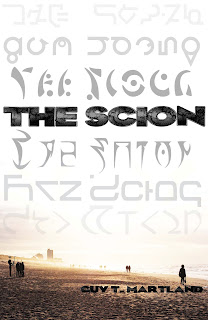
Anyway, cut to the chase: the cover for my Space Opera novel 'The Scion' was revealed this week! And, you know, I think it hits the spot. The novel starts on a beach (sorry, prologue haters). Figures are converging to face an oncoming alien threat in unison. The skies are filled with a skein of creatures, fast approaching over the water. Then... to put it simply, things don't go too well. The title font on the cover is meant to symbolise the clouds of these aliens, the Wraith, approaching. And the other fonts spell the same but in other texts. I'm not going to plot spoil, but there are other alien species involved, not just murderous, apocalyptic ones. (Big shout out to those involved in the cover design.)
If you like the sound of all this, the book will be published on the 1st July. There'll be some kind of Blog Tour as well, around this time. And I'm planning on Betelgeuse to go nova in celebration. The celestial clock is ticking - look up and watch the stars!
With the Cover Reveal came the blurb, which you can read over at Safkhet Publishing. But I've included it here as well, just for the hell of it:
The aliens from your nightmares are coming. The colonies of Earth are next. And it looks like nothing can stop them.
A blue star, a dying friend, a kidnap and the dusty contents of an old room: Septimus Esterhazy's life is about to change. As he blows cobwebs from the manual of an old spacecraft, hidden for decades, a Pandora's box creaks open.Little does he know that the universe's very nature is being threatened by a powerful alien race. Nor does he know that he is somehow involved with why the Wraith, destroyers of worlds, are coming.
The self-proclaimed 'Protectors of the Known Universe', the Sassrit, are trying to do everything they can to thwart a Wraith attack. But time is running out and resources are stretched.
A Sassrit agent, one of the shapeshifting Jarthiala, is recruited to help. The path he follows leads to the doorstep of a planet called D, an Earth colony, above which a blue star hangs, its light reflected in the eyes of Septimus below.
This is a journey which will change Septimus Esterhazy forever. It will make him question his nature. He will uncover secrets about his family that have lain dormant for years. And it will test the loyalty of those closest to him.
But first he has to watch his best friend die.
The Scion
Saturday, 30 May 2015
The R-word?


Some pictures of Tout Quarry Scultpure Park in Portland, Dorset. About 40 mins drive from where I live.


Some wiki-lite: Much of the stone which was used to construct St Paul's and Buckingham Palace, came from Portland. Some even travelled further afield, across the Atlantic, where it was used to construct the United Nations buildings in New York. The excavations left vast scars over the landscape. The quarry fell into disuse circa 1920, then in 1983 was reopened as a Sculpture Park.
 |
| 'Still Falling' - Antony Gormley (1983, incised work) |
 |
| 'Hearth' - Timothy Shutter (1989) |


This wasn't strictly the R-word (research) as the late, great Iain Banks put it. But it was a fascinating day out. Words started appearing shortly afterwards, which eventually became a story, so in retrospect...
 |
| Chesil Beach, looking towards Weymouth |
Subscribe to:
Posts (Atom)